soy-p22-tin-28h
SOY-P22 in an 82 mm tin, 28 hours
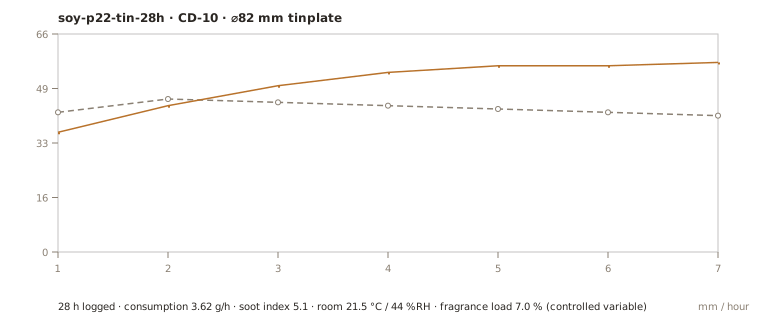
Seven sessions with a CD-10 wick at a 7 % load, run to test the claim that a high-shrink soy tolerates a heavier fragrance load. It does, and the cost shows up in the flame height rather than the pool: the flame shortens 1 mm per session from hour two onward.
Hourly record
| Hour | Pool ⌀ mm | Flame mm | Pool vs peak | Flame vs peak |
|---|---|---|---|---|
| 1 | 36.0 | 42.0 | ||
| 2 | 44.0 | 46.0 | ||
| 3 | 50.0 | 45.0 | ||
| 4 | 54.0 | 44.0 | ||
| 5 | 56.0 | 43.0 | ||
| 6 | 56.0 | 42.0 | ||
| 7 | 57.0 | 41.0 |
Pool diameter tracked the SOY-4641 record almost exactly for the first four hours, which is the expected result: shrinkage affects how the top sets, not how the pool grows. The divergence is in the flame, which fell from 46 mm to 41 mm across the record while the SOY-4641 flame only lost 7 mm in a longer run.
Soot index 5.1 at a 7 % load is the price of the load, not of the wax. A repeated run at 5 % on the same lot scored 3.8, and both numbers are kept on the specimen page so the trade is visible rather than argued.
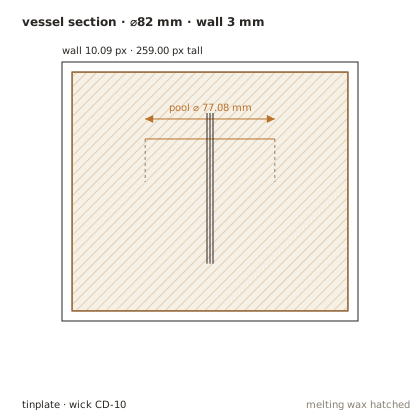
Vessel section
- Room
- 21.5 °C · 44 %RH
- Fragrance load
- 7.0 %
- Mushrooming
- 3 / 5
- Tunnelling risk
- 2 / 5
- Wet-spot risk
- 2 / 5
- Soot index
- 5.1 / 10
- Throw c/h
- 3 · 4
- Consumption
- 3.62 g/h
Failure modes observed
| Trigger | Threshold | Known failure modes |
|---|---|---|
| BURN-MUSHROOM | fragrance load → above 7 % | A carbon ball builds on the wick tip within two sessions and the flame shortens. Trim with a trimmer every session rather than picking it off. |
| BURN-FROST | cold surface → surface below 18 C | The cooling top blooms white if the room drops below 18 C between sessions. Store between sessions, do not leave the vessel in a cold workshop. |
Reading of the record
- P-06 four-hour burn sessionCapped multi-session burn with hourly dimensional readings
- SOY-P22Soy wax · 40.0–52.0 °C