PARA-4780
PARA-4780 paraffin: 47/50 with low oil
The 47/50 cut of the same fully refined series as PARA-4625, with oil content held to 0.3 %. Two degrees hotter and half a point harder, and the hardest paraffin on this site to pour without a hairline crack at the wick.
Melt band 20–90 °C — every live specimen pinned at its own interval
20 °C55 °C90 °C
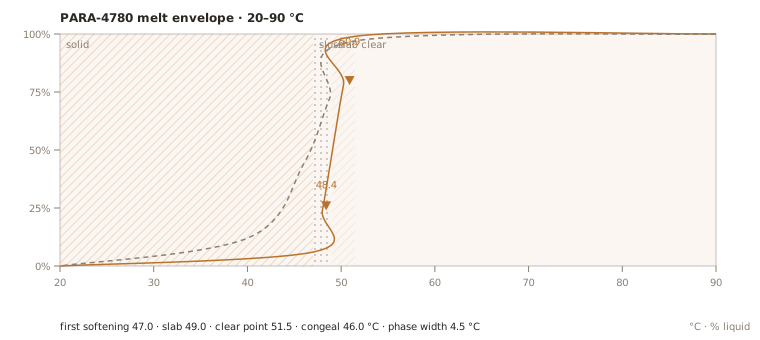
| First softening | 47.0 °C | Surface yields to light finger pressure. |
|---|---|---|
| Slab stage | 49.0 °C | Pourable but still slushy at the edges. |
| Clear point | 51.5 °C | Fully liquid, no seed crystals left. |
| Congeal point | 46.0 °C | Surface skins over on cooling. |
| Phase width | 4.5 °C | Clear point minus first softening. |
| DSC peaks | 48.4 °C · 50.9 °C | Calorimetry peak temperatures, 2 °C/min ramp. |
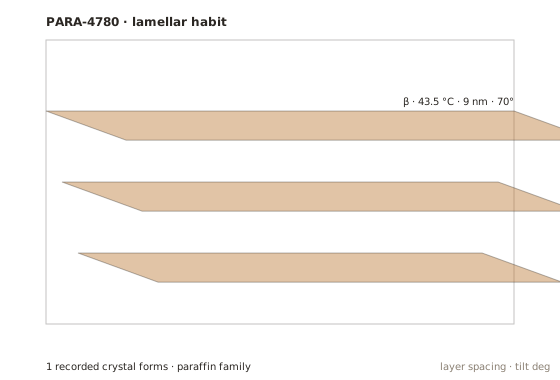
| Crystal β | 43.5 °C | 9 nm · 70° |
Oil content is the single number that separates a serviceable paraffin from a fragile one. PARA-4780 at 0.3 % oil is hard and translucent, takes a high polish and holds a sharp edge, but it has almost no plastic deformation before it fractures. The 13.5 % shrinkage is stored as internal stress.
The practical consequence is a two-temperature pour. Pour at 68 C to fill the mould, then hold the mould at 32 C for an hour rather than letting it fall to room temperature. The slow second stage lets the stress relax without a crack forming at the wick well.
Crystal forms
| Form | Transition | Layer | Tilt |
|---|---|---|---|
| beta β | 43.5 °C | 9 nm | 70° |
Same-family shrinkage comparison
Shrink — the filled bar is this grade, the hollow bars are its family siblings
Known failure modes
| Trigger | Threshold | Known failure modes |
|---|---|---|
| PAR-CRACK | demould temperature → below 21 C | A cold pillar cracks radially at the wick well. Bring it to 21 C over four hours before demoulding. |
| PAR-SET | pour temperature → above 72 C | Pouring hot traps a shrinkage void under the top skin that only appears after two burns. Pour at 68 C. |
Burn records for this grade
| Date | Burn report | Hour | Pool ⌀ mm | Soot 0–10 |
|---|---|---|---|---|
| 2026-10-01 | PARA-4780 free-standing pillar, 30 hours | 30 | 42.0 | 6.4 |
Protocol
- P-03 shrinkage by cast cylinderCast steel cylinder, dimensional measurement at three cooling stages
Other live specimens
- BEE-9400 Beeswax 11.5% · 88
- COCO-8300 Coconut wax 6.8% · 12
- PARA-1275 same family 12.9% · 21
- PARA-2281 same family 16.8% · 9
- PARA-4625 same family 14.2% · 15
- SOY-415 Soy wax 9.6% · 34
- SOY-4641 Soy wax 8.4% · 22
- SOY-P22 Soy wax 10.8% · 29