BEE-9400
BEE-9400 beeswax: the 65 C hard wax
Filtered beeswax with a clear point at 65.5 C, the highest on this site and the reason a pure beeswax candle needs a wick two series sizes above its diameter. Its 24 % adhesion is the strongest pull-away we have measured.
Melt band 20–90 °C — every live specimen pinned at its own interval
20 °C55 °C90 °C
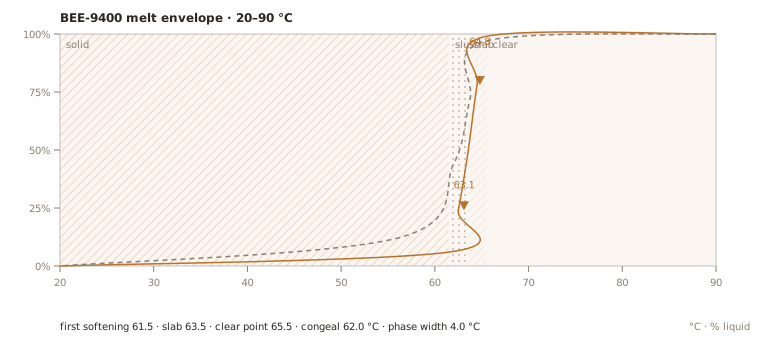
| First softening | 61.5 °C | Surface yields to light finger pressure. |
|---|---|---|
| Slab stage | 63.5 °C | Pourable but still slushy at the edges. |
| Clear point | 65.5 °C | Fully liquid, no seed crystals left. |
| Congeal point | 62.0 °C | Surface skins over on cooling. |
| Phase width | 4.0 °C | Clear point minus first softening. |
| DSC peaks | 63.1 °C · 64.8 °C | Calorimetry peak temperatures, 2 °C/min ramp. |
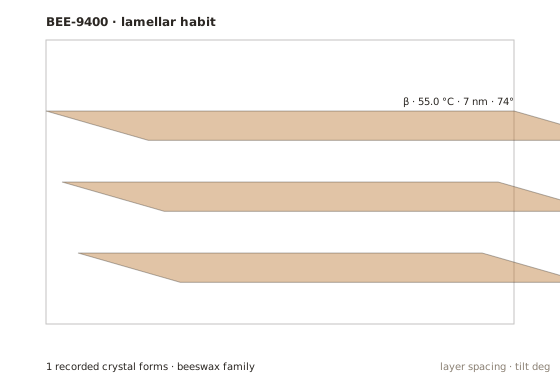
| Crystal β | 55.0 °C | 7 nm · 74° |
Beeswax is not a triglyceride and not an alkane: it is a mixture of long-chain esters, hydrocarbons and free acids, which is why its melt band is narrow but its congealing point sits only 3.5 C below the clear point. It sets fast and it sets hard.
A needle penetration of 88 means a beeswax candle takes a wick roughly two series sizes larger than the same diameter in soy. It also means the wax does not level itself: a beeswax candle keeps whatever surface it was poured with, which is the whole appeal of the grade and the reason it is the hardest to pour well.
Crystal forms
| Form | Transition | Layer | Tilt |
|---|---|---|---|
| beta β | 55.0 °C | 7 nm | 74° |
Same-family shrinkage comparison
Shrink — the filled bar is this grade, the hollow bars are its family siblings
- BEE-9400 11.5 %
Known failure modes
| Trigger | Threshold | Known failure modes |
|---|---|---|
| BEE-SCORCH | melt temperature → above 90 C | Scorching darkens the block and leaves a burnt note that survives the pour. A water bath at 75-80 C melts it in fifteen minutes without damage. |
| BEE-TUNNEL | wick series → below 2 sizes up | An under-wicked beeswax candle tunnels permanently and cannot be recovered by trimming. Start two series sizes above the soy equivalent. |
| BEE-SPUTTER | oil binding → load above 4 % | Beeswax holds almost no fragrance oil; above 4 % the oil pools at the wick base and the flame sputters. Blend with soy rather than loading harder. |
Other live specimens
- COCO-8300 Coconut wax 6.8% · 12
- PARA-1275 Paraffin wax 12.9% · 21
- PARA-2281 Paraffin wax 16.8% · 9
- PARA-4625 Paraffin wax 14.2% · 15
- PARA-4780 Paraffin wax 13.5% · 17
- SOY-415 Soy wax 9.6% · 34
- SOY-4641 Soy wax 8.4% · 22
- SOY-P22 Soy wax 10.8% · 29