PARA-4625
PARA-4625 paraffin: the reference 46/48
A fully refined 46/48 C paraffin, prilled and food grade. Its melt band is only 4.5 C wide, which is why paraffin takes a mirror-flat top and why a wick sized for soy will drown in it.
Melt band 20–90 °C — every live specimen pinned at its own interval
20 °C55 °C90 °C
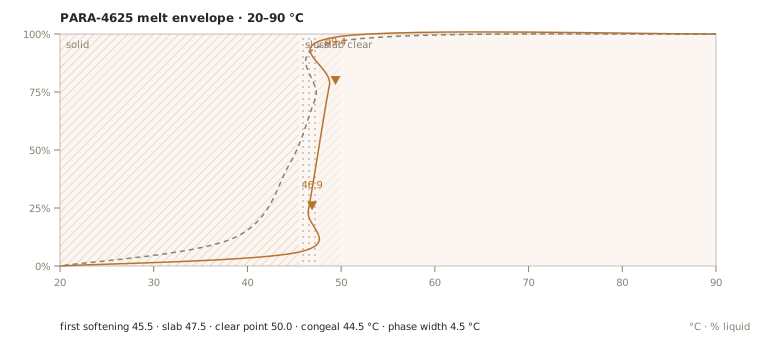
| First softening | 45.5 °C | Surface yields to light finger pressure. |
|---|---|---|
| Slab stage | 47.5 °C | Pourable but still slushy at the edges. |
| Clear point | 50.0 °C | Fully liquid, no seed crystals left. |
| Congeal point | 44.5 °C | Surface skins over on cooling. |
| Phase width | 4.5 °C | Clear point minus first softening. |
| DSC peaks | 46.9 °C · 49.4 °C | Calorimetry peak temperatures, 2 °C/min ramp. |
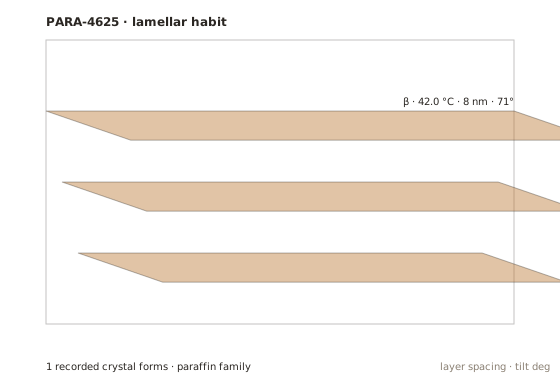
| Crystal β | 42.0 °C | 8 nm · 71° |
The paraffin molecule is a straight alkane chain, and the prilled 46/48 grade is a tight cut of C20 to C24 chains. A tight cut means a narrow melt band: 45.5 to 50.0 C covers the entire transition, against 10.5 C for SOY-4641. Nothing slushes for long, so the pour is more forgiving and the surface is flatter.
Two properties bite. Shrinkage at 14.2 % is nearly double the soy figure and produces the classic well around the wick on the second burn. Oil binding at 3.1 % is low enough that a 6 % fragrance load will bead on the surface if the melt was not stirred for a full two minutes.
Crystal forms
| Form | Transition | Layer | Tilt |
|---|---|---|---|
| beta β | 42.0 °C | 8 nm | 71° |
Same-family shrinkage comparison
Shrink — the filled bar is this grade, the hollow bars are its family siblings
Known failure modes
| Trigger | Threshold | Known failure modes |
|---|---|---|
| PAR-DROWN | wick sizing → below 2.5 mm | A soy-sized wick cannot hold a pool in a 4.5 C band and drowns inside two hours. Size up one series step. |
| PAR-BEAD | stir time → under 120 s | Fragrance beads on the cooled surface because the oil was never held in the melt. Stir a full two minutes and pour within four. |
| PAR-WELL | second burn → shrinkage over 13 % | The wax pulls down around the wick and forms a well that starves the flame of melt. Trim to 6 mm and burn long enough to level. |
Other live specimens
- BEE-9400 Beeswax 11.5% · 88
- COCO-8300 Coconut wax 6.8% · 12
- PARA-1275 same family 12.9% · 21
- PARA-2281 same family 16.8% · 9
- PARA-4780 same family 13.5% · 17
- SOY-415 Soy wax 9.6% · 34
- SOY-4641 Soy wax 8.4% · 22
- SOY-P22 Soy wax 10.8% · 29