SOY-415
SOY-415 soy wax: the high-melt soy
Same chemistry as SOY-4641, shifted seven degrees hotter. The clear point at 56.5 C makes it the grade to reach for when a container runs warm, and the price is a harder, more brittle set that chips at the rim.
Melt band 20–90 °C — every live specimen pinned at its own interval
20 °C55 °C90 °C
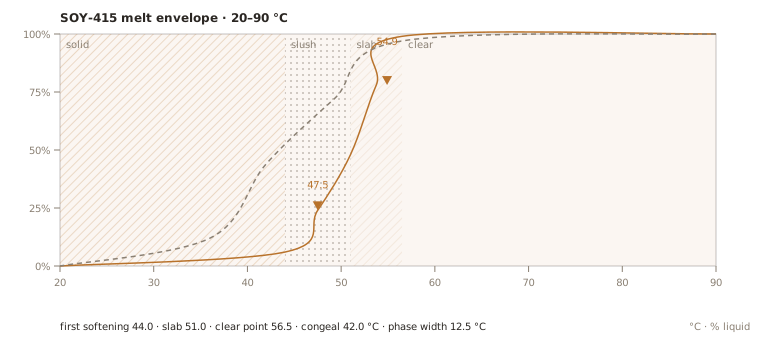
| First softening | 44.0 °C | Surface yields to light finger pressure. |
|---|---|---|
| Slab stage | 51.0 °C | Pourable but still slushy at the edges. |
| Clear point | 56.5 °C | Fully liquid, no seed crystals left. |
| Congeal point | 42.0 °C | Surface skins over on cooling. |
| Phase width | 12.5 °C | Clear point minus first softening. |
| DSC peaks | 47.5 °C · 54.9 °C | Calorimetry peak temperatures, 2 °C/min ramp. |
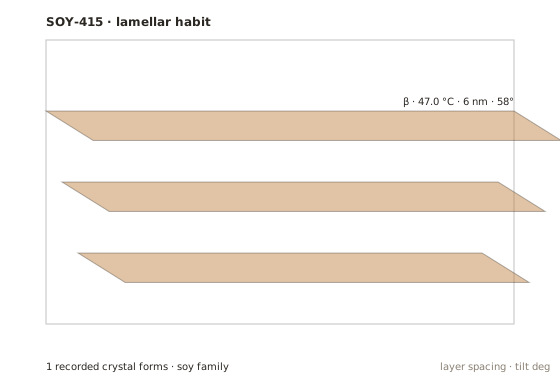
| Crystal β | 47.0 °C | 6 nm · 58° |
The seven-degree shift comes from a harder hydrogenation cut, not from an additive. That shows up in the crystal data: the beta transition sits 6 C above SOY-4641 and the lamellae are thicker, 5.6 nm against 4.2 nm, which is what makes the finished candle feel like a hard bar of soap.
Adhesion is the trade. At 14.5 % pull-away on a 76 mm glass, SOY-415 releases from the wall more readily than the softer soy and will rattle if the wick is centred off-axis. It is a better grade for tins than for clear glass.
Crystal forms
| Form | Transition | Layer | Tilt |
|---|---|---|---|
| beta β | 47.0 °C | 6 nm | 58° |
Same-family shrinkage comparison
Shrink — the filled bar is this grade, the hollow bars are its family siblings
Known failure modes
| Trigger | Threshold | Known failure modes |
|---|---|---|
| SOY-GRAIN | cure temperature → above 26 C | Cooling too slowly coarsens the crystal and the surface turns from satin to grainy. Cure at 21-24 C, not in a warm kitchen. |
| SOY-CHIP | wall thickness → under 3 mm | Thin glass plus a 14.5 % pull-away leaves a free wax slug that chips at the rim in transit. Use a thicker vessel or a tin. |
Other live specimens
- BEE-9400 Beeswax 11.5% · 88
- COCO-8300 Coconut wax 6.8% · 12
- PARA-1275 Paraffin wax 12.9% · 21
- PARA-2281 Paraffin wax 16.8% · 9
- PARA-4625 Paraffin wax 14.2% · 15
- PARA-4780 Paraffin wax 13.5% · 17
- SOY-4641 same family 8.4% · 22
- SOY-P22 same family 10.8% · 29