PALM-7750
PALM-7750 palm wax: the crystalline feather
Palm wax clears at 61.0 C and, uniquely on this site, grows a visible crystalline surface. The feather pattern on a palm pillar is not a finish applied after pouring; it is the crystal habit the wax takes as it cools, and it changes with the mould temperature.
Melt band 20–90 °C — every live specimen pinned at its own interval
20 °C55 °C90 °C
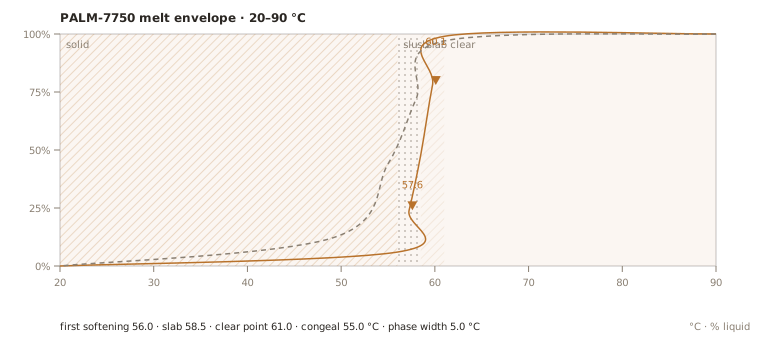
| First softening | 56.0 °C | Surface yields to light finger pressure. |
|---|---|---|
| Slab stage | 58.5 °C | Pourable but still slushy at the edges. |
| Clear point | 61.0 °C | Fully liquid, no seed crystals left. |
| Congeal point | 55.0 °C | Surface skins over on cooling. |
| Phase width | 5.0 °C | Clear point minus first softening. |
| DSC peaks | 57.6 °C · 60.1 °C | Calorimetry peak temperatures, 2 °C/min ramp. |
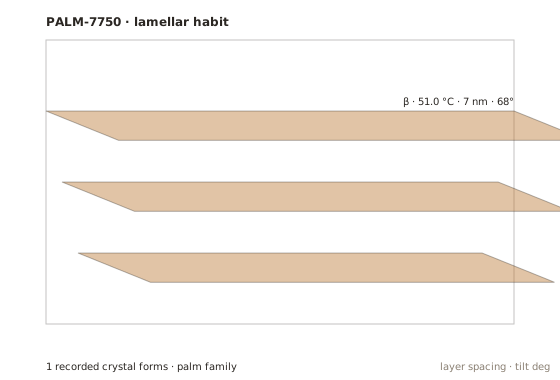
| Crystal β | 51.0 °C | 7 nm · 68° |
The crystal form is a beta habit with a 7.2 nm lamella, and the feathering comes from radial growth at the mould wall. Above 40 C mould temperature the pattern is fine and even; below 30 C it turns coarse and the finish reads as frost rather than feather.
Two practical notes. Palm wax adhesion is the highest here at 26.5 %, so it releases from glass without a fight and is a poor choice for a clear container. And frosting risk at 4 out of 5 means the surface bloom is part of the look, not a defect to be polished away.
Crystal forms
| Form | Transition | Layer | Tilt |
|---|---|---|---|
| beta β | 51.0 °C | 7 nm | 68° |
Same-family shrinkage comparison
Shrink — the filled bar is this grade, the hollow bars are its family siblings
- PALM-7750 15.4 %
Known failure modes
| Trigger | Threshold | Known failure modes |
|---|---|---|
| PALM-COARSE | mould temperature → below 30 C | A cold mould gives a coarse, frosted surface instead of feathering. Warm the mould to 40 C before pouring. |
| PALM-BLOOM | storage humidity → above 70 %RH | The crystalline top draws moisture and blooms white within a month. Store under 60 %RH or wrap the pillar. |
| PALM-STICK | adhesion → 26.5 % pull-away | Palm wax releases from glass almost completely, so a clear container holds a loose slug. Use a mould or a tin. |
Other live specimens
- BEE-9400 Beeswax 11.5% · 88
- COCO-8300 Coconut wax 6.8% · 12
- PARA-1275 Paraffin wax 12.9% · 21
- PARA-2281 Paraffin wax 16.8% · 9
- PARA-4625 Paraffin wax 14.2% · 15
- PARA-4780 Paraffin wax 13.5% · 17
- SOY-415 Soy wax 9.6% · 34
- SOY-4641 Soy wax 8.4% · 22
- SOY-P22 Soy wax 10.8% · 29