BLEND-CB135
BLEND-CB135 coconut-beeswax 65:35
A pre-compounded 65 % hydrogenated coconut to 35 % filtered beeswax blend that clears at 51.0 C. It exists because the two components fail in opposite directions: the coconut wax burns clean and sets soft, the beeswax sets hard and burns sootier.
Melt band 20–90 °C — every live specimen pinned at its own interval
20 °C55 °C90 °C
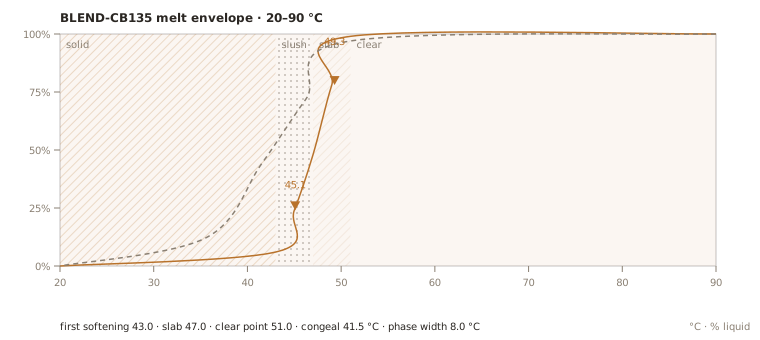
| First softening | 43.0 °C | Surface yields to light finger pressure. |
|---|---|---|
| Slab stage | 47.0 °C | Pourable but still slushy at the edges. |
| Clear point | 51.0 °C | Fully liquid, no seed crystals left. |
| Congeal point | 41.5 °C | Surface skins over on cooling. |
| Phase width | 8.0 °C | Clear point minus first softening. |
| DSC peaks | 45.1 °C · 49.3 °C | Calorimetry peak temperatures, 2 °C/min ramp. |
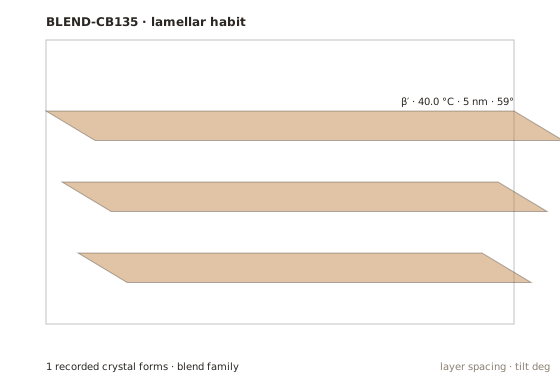
| Crystal β′ | 40.0 °C | 5 nm · 59° |
The clear point lands at 51.0 C, which is 16.5 C above pure coconut and 14.5 C below pure beeswax, and it is not a linear interpolation. The beeswax ester network dominates the melt behaviour even at 35 %, while the coconut triglycerides dominate the burn behaviour. That split is the whole reason a blend like this is worth buying rather than making.
The measured compromise is a 9.2 % shrinkage and 31 units of needle penetration: hard enough to sit upright in a tin, soft enough that the top self-levels. Oil binding at 5.8 % sits between the two parents and is the number that decides whether a 6 % load weeps.
Crystal forms
| Form | Transition | Layer | Tilt |
|---|---|---|---|
| beta-prime β′ | 40.0 °C | 5 nm | 59° |
Same-family shrinkage comparison
Shrink — the filled bar is this grade, the hollow bars are its family siblings
- BLEND-CB135 9.2 %
Known failure modes
| Trigger | Threshold | Known failure modes |
|---|---|---|
| BLD-SCORCH | melt temperature → above 75 C | The coconut fraction scorches first and the beeswax keeps the note dissolved until the candle is lit. Melt to 75 C at most. |
| BLD-SEP | hold time → over 90 min above 70 C | Held hot too long the blend stratifies and the top of a pillar goes tacky. Melt, blend and pour inside ninety minutes. |
| BLD-WEEP | fragrance load → above 8 % | Above 8 % the coconut fraction cannot hold the oil and a ring appears at the wall. Keep at 6 % or below. |
Other live specimens
- BEE-9400 Beeswax 11.5% · 88
- COCO-8300 Coconut wax 6.8% · 12
- PALM-7750 Palm wax 15.4% · 26
- PARA-1275 Paraffin wax 12.9% · 21
- PARA-2281 Paraffin wax 16.8% · 9
- PARA-4625 Paraffin wax 14.2% · 15
- PARA-4780 Paraffin wax 13.5% · 17
- SOY-415 Soy wax 9.6% · 34
- SOY-4641 Soy wax 8.4% · 22
- SOY-P22 Soy wax 10.8% · 29