BLEND-PB93
BLEND-PB93 palm-beeswax 70:30
A 70 % crystalline palm to 30 % filtered beeswax blend with a clear point of 64.0 C, the hardest material on this site short of pure beeswax. It is built for pillars that have to hold a carved or moulded edge at room temperature.
Melt band 20–90 °C — every live specimen pinned at its own interval
20 °C55 °C90 °C
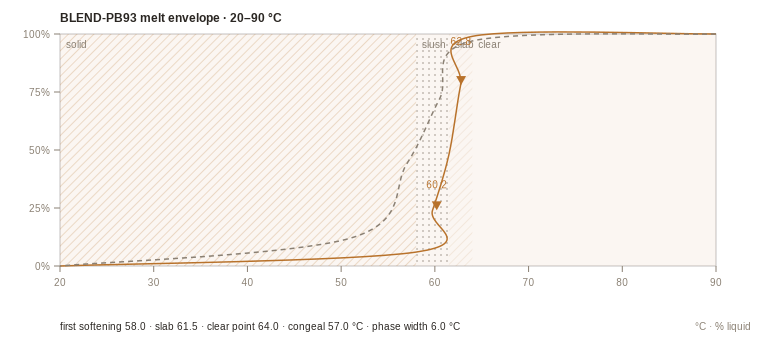
| First softening | 58.0 °C | Surface yields to light finger pressure. |
|---|---|---|
| Slab stage | 61.5 °C | Pourable but still slushy at the edges. |
| Clear point | 64.0 °C | Fully liquid, no seed crystals left. |
| Congeal point | 57.0 °C | Surface skins over on cooling. |
| Phase width | 6.0 °C | Clear point minus first softening. |
| DSC peaks | 60.2 °C · 62.8 °C | Calorimetry peak temperatures, 2 °C/min ramp. |
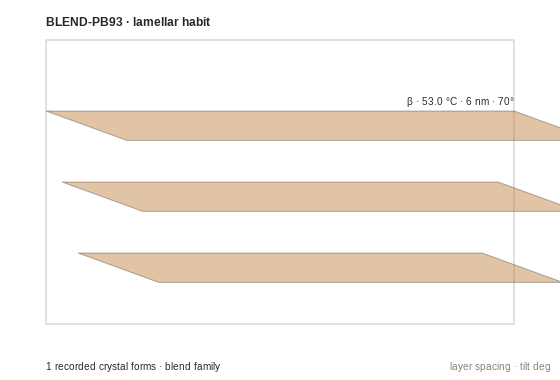
| Crystal β | 53.0 °C | 6 nm · 70° |
Blending palm with beeswax at 70:30 raises the clear point only 3 C above the palm alone but raises the needle penetration from 26 to 52 units. That is the point of the blend: the crystalline palm supplies the feather finish and the structural hardness, while the beeswax plasticises the matrix enough that the pillar survives being knocked.
The 25 units of adhesion is the strongest pull-away of any blend here, and the reason this wax should never be poured into a glass vessel. In a metal mould the same property is an advantage: the pillar releases cleanly with a single tap once it has reached room temperature.
Crystal forms
| Form | Transition | Layer | Tilt |
|---|---|---|---|
| beta β | 53.0 °C | 6 nm | 70° |
Same-family shrinkage comparison
Shrink — the filled bar is this grade, the hollow bars are its family siblings
- BLEND-CB135 9.2 %
- BLEND-PB93 13.1 %
Known failure modes
| Trigger | Threshold | Known failure modes |
|---|---|---|
| BLD-CRACK | vessel material → adhesion above 24 % | Poured into glass this blend contracts hard enough to crack the vessel within an hour. Cast in metal or free-standing only. |
| BLD-EDGE | pour temperature → below 66 C | Cool wax will not fill a moulded edge and leaves a rounded, dull rim. Pour at 70 C into a 40 C mould. |
| BLD-SCORCH | hold temperature → above 85 C | The beeswax fraction scorches and the palm goes yellow. Hold at 70-75 C and no higher. |
Other live specimens
- BEE-9400 Beeswax 11.5% · 88
- BLEND-CB135 same family 9.2% · 31
- COCO-8300 Coconut wax 6.8% · 12
- PALM-7750 Palm wax 15.4% · 26
- PARA-1275 Paraffin wax 12.9% · 21
- PARA-2281 Paraffin wax 16.8% · 9
- PARA-4625 Paraffin wax 14.2% · 15
- PARA-4780 Paraffin wax 13.5% · 17
- SOY-415 Soy wax 9.6% · 34
- SOY-4641 Soy wax 8.4% · 22
- SOY-P22 Soy wax 10.8% · 29